

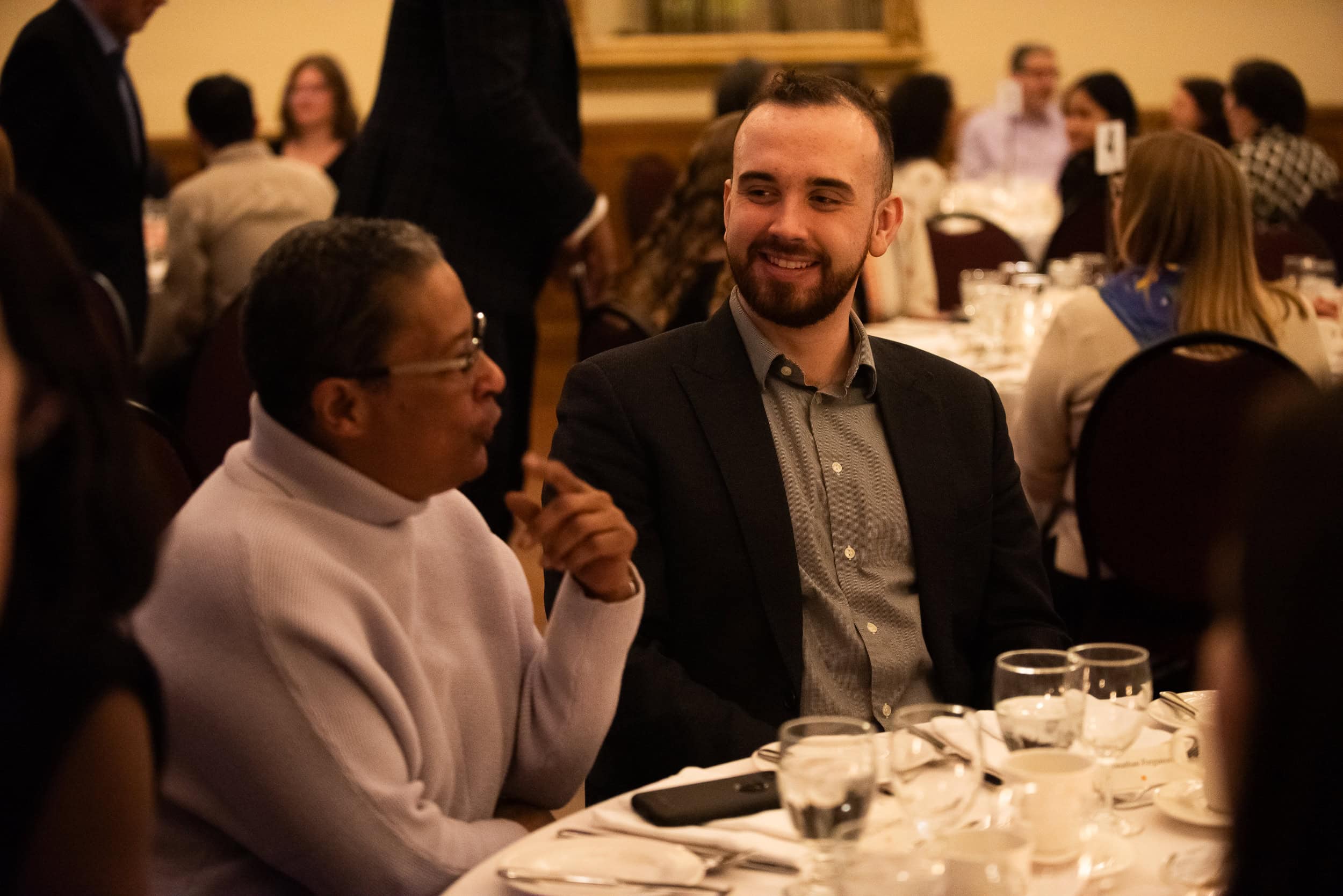
Each McCall MacBain Scholar is matched with a carefully selected mentor — someone with a distinguished career and a willingness to support and challenge the next generation of leaders. Our mentors come from a wide range of fields, including business, academia, healthcare, law, public policy, and international development. They bring experience, perspective, and a genuine interest in helping scholars grow.
These relationships are scholar-led and take many forms. Some focus on navigating career choices or graduate school, while others offer space for personal reflection and growth.
In the blog posts below, two scholars highlight how meaningful mentorship—rooted in trust, presence, and personal connection—has shaped their growth as leaders, offering guidance not only in their careers but also in how they reflect, engage with the community, and navigate moments of transition.
Tireless Changemaking: Mentorship Lessons from Marlene Jennings

Written by: Jonathan Ferguson
What did you seek from a mentor?
A hallmark of the McCall MacBain Scholars leadership development program is mentorship, and I went into the mentorship process with a lot of enthusiasm. I had a good feeling that the mentor matching process would pair me with the right person, who would help me plan long-term. Someone who could help “lift the fog” at an important stage of my life, career, and community engagement, at a time when I’m still trying to figure out exactly what it is I want to do and how I want to contribute.
Who is your mentor?
Needless to say, I was over the moon when I found out I’d been paired with Marlene Jennings. The more I read about Marlene, the more I realized just how lucky an opportunity stood before me. It’s hard to know where to begin with explaining the breadth and depth of Marlene’s community engagement (this CBC article gives a more comprehensive overview) – but a common thread stands out: Marlene has just never stopped. Her momentum is incredible; she finds ways to contribute to her community every day. Her time serving as a Member of Parliament now just seems like one of the earlier chapters in her story of community leadership – and that persistence was immediately inspiring.
How often do you meet with your mentor, and how do you make the most of your mentoring relationship?
Since I moved to Montreal in the summer of 2023, Marlene and I have met regularly and always in person – for coffees, lunch, and once even alongside another McCall MacBain Scholar who wanted to tag along and get to know her better too! There was – and is – so much I want to learn from Marlene that at first, it felt hard to know where to start. As we got to know each other, that quickly changed. These days, I’ll sometimes come with specific questions, like how to get more deeply involved with my community. Other times, we just catch up.
We’ve covered a lot during our meetings – everything from career planning ideas to discussing politics and chatting about concerts we’ve been attending lately. Every time we’ve met, I’ve learned something, and every time, I’ve had fun. Marlene adds,
I believe that mentorship programs enhance the student’s learning experience; therefore, more should be offered and integrated into just about every educational program. As well, though many may not realize this, the mentor is also benefiting as they learn too from their mentee during their shared journey.
How does your mentor help you, and how has your mentorship affected your personal growth?
A challenge I’ve had with community engagement has been knowing where to get involved. Since moving to Montréal, I’ve faced what can only be described as a good problem: I feel increasingly torn between my home community in the Maritimes – a place I had originally planned to move back to as soon as I graduated from McGill – and the community I’m becoming a part of here in Montréal. As my plans develop, Marlene has been an invaluable support in helping me appreciate the multifaceted nature of community engagement and the range of ways to be involved in more than one community – especially in the long term.
How should future mentees make the most of a mentor relationship?
Marlene has such a positive impact on my McGill and McCall MacBain Scholarship experience. Her thoughtful insight, drive, and humour have helped me stay grounded in why I first came to law school. My main advice for future mentees would be to get to know your mentor on a personal level. Establishing that familiarity has made our conversations not only so insightful and helpful but also feel like talking with a friend. Getting to know each other on a personal level and building trust can create the foundation for a mentorship relationship that is as inspiring and meaningful as it is effortless and fun. I already know that when I look back on my McCall MacBain Scholarship experience, these chats with Marlene will always be top of mind.
A Text Away: The Mentorship That Changed Everything

Written by: Racheal Afriyie
When I joined the McCall MacBain Scholars community, I knew mentorship would be an essential part of my experience as a scholar. What I didn’t anticipate was how profoundly it would shape not just my academic or professional path, but also how I think, lead, and see myself in the world. At the heart of that journey has been my mentor, Chris Henschel. Chris, a Senior Policy Advisor at Environment and Climate Change Canada, is someone whose work sits at the intersection of everything I care about. That is, community-based conservation, forest governance and policy. But more than his credentials, it’s his character that has left the deepest impact on me. From our very first meeting, I felt seen, heard, and encouraged not just as a scholar but as a person navigating the complexities of growth, ambition, and environmental advocacy.
What I Looked for in a Mentor
When I imagined the ideal mentor, I hoped for someone who wouldn’t just offer advice but would also listen actively, challenge me thoughtfully, and hold space for both my aspirations and uncertainties. I wanted someone with experience in conservation and policy who could help me think strategically, but also someone who understood who I am, where I am coming from and what it meant to lead with care, humility, and long-term vision. Chris has been all of that and more.
An Unusually Supportive Mentorship
Unlike many structured or formal mentorships with rigid meeting schedules where communication is limited to once-a-semester meetings, my relationship with Chris has always been flexible and deeply human. He is literally just a text away, and I don’t say that lightly. Whether I need to talk through a decision, explore a new idea, or simply say, “I’m overwhelmed,” Chris is there, always ready to listen, always present. He doesn’t just “mentor” ………he shows up. At a time when I was far from home, dealing with both the pressures of graduate school, health issues and personal uncertainties, Chris consistently checked in to see how I was doing. Not out of obligation, but out of genuine concern. That kind of support, particularly as an international student away from home, made a huge difference. It reminded me that I wasn’t just a scholar to him; I was valued as a person, and those messages meant everything to me.
Chris has also gone above and beyond in helping me shape my career trajectory. From helping me draft my CV and cover letters to helping me navigate the job market, he didn’t just give me advice; he offered his network. He connected me to professionals in conservation, advocacy, and policy who helped me understand where I might fit in and where I could grow next. Through his network, I secured a job that aligned perfectly with my values and career goals. In our conversations, he’s asked thoughtful questions that pushed me to reflect: What kind of leader do you want to be? Where do you see your impact in the long term? How do you stay grounded while aiming high? He’s helped me think through not just what’s next after graduate school, but how to ensure my choices align with my identity and mission.
A Relationship Rooted in Trust and Presence
What makes Chris’ mentorship so impactful is not just his expertise or network, although both are invaluable, but the way he shows up. He doesn’t try to be prescriptive. He meets me where I am, listens without judgment, and encourages me to trust myself more deeply. Whether we’re talking about forest conservation, PhD studies, moving to a new place or how I am feeling about starting something new, his advice is grounded in empathy and real-life experience. He makes space for both my ambition and my vulnerability, a rare and powerful balance.
Learning to Celebrate the Little Wins
One moment that stands out vividly in my mentorship journey with Chris wasn’t about a big career breakthrough or major academic milestone; it was about something much smaller, but just as important. I had just wrapped up a demanding week filled with research deadlines, back-to-back meetings, and emotional exhaustion. When I shared everything I had been juggling, my instinct was to downplay it, to treat surviving the week as just the bare minimum. But Chris stopped me and said something that stayed with me: “You know, you need to celebrate that. This is worth celebrating because it is a big deal.” It hit me because I realized how often I move from one goal to the next without pausing. Chris reminded me that life isn’t just about the big achievements, it’s about recognizing the small victories that make those big moments possible. Since then, I’ve made it a practice to pause and celebrate the little things, whether it’s sharing a moment of joy with a friend, going out for ice cream, or simply giving myself permission to rest. Chris taught me that celebration is not indulgence, it’s a form of gratitude, reflection, and self-recognition. And in a world where many of us, especially young people, are constantly chasing what’s next, that lesson has grounded me more than any textbook ever could.
Lessons I will carry forward
From Chris, I’ve learned that mentorship is not transactional; it’s relational. It’s about consistency, empathy, and trust. It’s about knowing that someone believes in your potential, even on days you doubt it yourself. The most valuable part of our relationship isn’t just the advice or the network (though those have been incredible). It’s the feeling of being supported without condition. It’s knowing that someone who has walked this path is walking beside you, cheering you on, and reminding you that you’re not alone.
Advice for Future Mentees
To anyone about to begin a mentorship, be open. Be honest about where you are and where you hope to go. Ask questions, but also share your fears. A good mentor doesn’t expect you to have it all figured out. In fact, the best conversations I’ve had with Chris started from places of uncertainty. Also, don’t underestimate the power of kindness and availability. If your mentor shows up for you, show up too. Prepare for your meetings, follow up, and keep the conversation going. Don’t wait for big milestones to connect. Sometimes the most transformative moments come from the smallest, most honest conversations. Mentorship isn’t a one-time transaction; it’s an evolving relationship that can shape the trajectory of your life.
Final Reflection
Through his knowledge, availability, and unwavering support, Chris has redefined what mentorship means for me. He’s helped me see beyond the next step, towards a future that blends purpose, community, and leadership. Though we are yet to meet physically, he has guided me professionally, supported me personally, and reminded me to celebrate the journey, not just the destination. His presence in my life has been a quiet force of stability, care, and insight, the kind that doesn’t just shape careers, but shapes character. And for that, I’m deeply grateful. Like I always say, God has strategically placed some people in my path to help me along this journey of life, and Chris, I can confidently say, is one of those people.
The Responsibilities of a Mentor – Chris Henschel
I am deeply honoured and touched by Racheal’s tribute. It is hard for me to believe that I deserve such praise. And I am gratified that Racheal found such value in my approach of offering connection, support and friendship above all else. I did not read any papers or attend any presentations… in this way, I felt like I was not doing my job. But I think Racheal has reminded us of what is important in all human relationships: connection, presence, kindness, humility, support. I hope that Racheal’s testament to the importance of these values resonates with other mentors-to-be.
When I read of the profoundly positive impact of my ‘showing up’ had on Racheal’s experience, I deeply regretted the time that I did not. Busy and distracted for a time, meaning to reach out but forgetting, I let our conversations slide. Only when Racheal expressed her concern for me did I snap out of it. This was a reminder to me and would serve all mentors: we are taking on a commitment and responsibility not only to provide academic support, but also to the well-being of your mentee. Mentors: solemnly embrace and uphold this responsibility. Your mentorship is not a side-of-the-desk affair – It’s a big deal.
Racheal: thank you for the honour and privilege of being your mentor. I wish you all the best in life and your future endeavours… text me, or better yet, give me a call and let me know what you are up to! – Chris